Every hard drive in a modern computer is connected to the system through a storage controller. This controller typically can communicate with the hard drive via a number of different interface protocols. For maximum compatibility many computers are configured in the BIOS to use the older IDE interface protocol to communicate with modern SATA hard drives. This setting is acceptable for the average computer user but IDE lacks support for new technologies such as native command queuing (NCQ) and hot-plugging hard drives (add or remove drives without restarting the computers).
Intel invented a new storage controller interface known as AHCI (Advanced Host Controller Interface) that supports these new technologies with modern SATA hard drives. If you have a hard drive that supports NCQ, it is worth a try to see if your disk performance improves with your workload.
The main problem preventing users from changing the storage interface protocol from IDE to AHCI in the past has been blue screens that could only be cured by undoing the BIOS change or reinstalling Windows. The cause of the problem is the mass storage driver installed when Windows was first setup. Since IDE was enabled at install only the IDE storage driver was configured in Windows. With the AHCI driver missing, Windows cannot read from the hard drive and throws a BSOD with error code 0x0000005B.
Now there is an easy solution that will allow you to switch between IDE and AHCI in the bios and Windows will boot without any problems. The key is to enable the AHCI driver in Windows before you make the setting change in the BIOS.
For most users this will work:
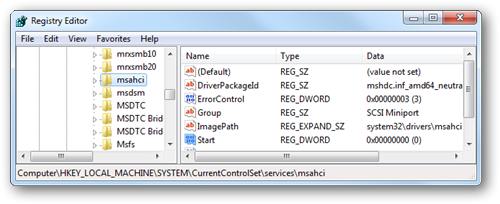
- Open Registry Editor and navigate to HKEY_LOCAL_MACHINE\SYSTEM\CurrentControlSet\services\msahci.
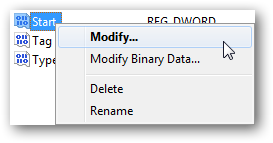
- Right click on the Start registry DWORD and
select Modify.
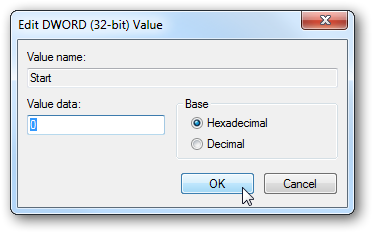
- Set the value to 0 and click OK.
- Now the Start setting should be set to 0.
- Reboot and enable the AHCI setting in your BIOS.
If you are using a RAID adapter or other interface try the following:
- Open up Registry Editor and naviage to HKEY_LOCAL_MACHINE\SYSTEM\CurrentControlSet\services\iaStorV OR HKEY_LOCAL_MACHINE\SYSTEM\CurrentControlSet\services\iaStor.
- Repeat the steps above.
Not all users will see a major performance improvement with AHCI and a SATA hard drive but NCQ can be very helpful under the right workload. Post your experience and setup in the comments below.



Best Regards
I always wanted to do this,after i installed my Win7 64 Bit Ultimate a year ago,but it was installed automatically SATA on IDE.
I have ASUS M4N82 Deluxe board and i changed everything like you write above and it works fine and after i reinstalled nforce SATA-IDE driver again,system shows under IDE the new nforce SATA and all the CD-DVD drives are now Scsi and they all work fine.
The only thing is that,the system start-up needs maybe 3-5 seconds more but everything works much faster,copying is faster..
Thanks a lot for the TIP.
Kurt.
Thanks. I needed to change to AHCI for eSATA support on my Dell E6510 and everwhere I looked people were saying to reinstall. Thanks to you I made the single regedit and it worked. Thanks again.
i had been trying to get it worked out for 2months. I did have to make sure i re set my boot order since i had my boot drive in 1 instead of 0 . i have a CoolerMaster II advance with the top sata slot for hdd to hot swap and could never get it together. I have a gigabyte 890FXA ud5 board and couldnt figure how to make it work without reinstalling the OS and i did not want to do that.
2 show as scsi and 2 in the ahci, i get a prompt at boot to press any key to continue , though i do not have to press any key, it just boots the same way regardless. it just ids the one external hdd and one samsung. hard to tell one from the other since they are all the exact same numbers. I have no idea if this is typical or not, i do not know if a raid array is set up somehow that i am not consciously trying to do. 2 drives are listed as ncq for sure, i had a similar problem that poster GigaByte69 listed and almost the same drives i have win7 x 64 3sata II internals and the one external sata II in an esata plug. i do not notice any real performance differences, which is good in a way because nothing got messed up. i may have slowed down some disc to disc copy speeds though. i have tested the hdds and all are good run just above room temps in the box the hottest one is the external, i used crystal disc disk mark or disk info to check them as well as pc wiz
Does anyone know how to reverse this on a Dell M90???
It worked so well on my M6400 that I just did it on the M90, but it now it won't boot...
Great tip by the way!
Try
HKEY_LOCAL_MACHINE\System\CurrentControlSet\Services\Msahci
- startup is faster, cut off some seconds.
- when copying the burst speed stays there a bit more.
- while compressing, the performance in general it's better.
There are no big differences, but it's there. The ncq helps mostly in multitasking.
Be careful going to AHCI here it great to switch but only if all your Disc burning drives are SATA drives. If there IDE you'll break your Disc burning setup. And it most difficult to revert it back once the achi drivers are loaded. It told me day and registry mods to force the Dell to revert back.
In the dell case the 16x burner work like a champ in all the burning applications once reverted the system back to IDE.
rock
I had an Intel D845WN mobo-based PC running Win XP SP2, with 2 ATA IDE HDDs.
After a respectable 10 years of operation, the mobo bricked, and I got a new DH67CL mobo. This mobo doesn't support IDE, therefore I got a Dynamode IDE PCI "Host Storage Controller", tucked it into the PCI slot on the mobo, and connected the two HDDs.
Now, what needs to be done is to do a repair install of Win XP, in order that the system do a new "hardware enumeration" and renew the HAL (Hardware Abstraction Layer).
The problem is, that when I try that, booting from the XP SP2 install disk, it does not offer the repair install option!, but instead goes ahead, loads lots of drivers, then goes: "starting windows", and throws a 0x7b BSOD.
I went into the BIOS and switched from AHCI to IDE: didn't help.
Any help will be appreciated because I'm stuck. Thank In Advance - Gail H
@GailH
Make sure the PCI slot is set as a bootable device in your BIOS. If its already set, you may have a "bunk" HSC. 7b code indicates a hardware failure.
ASRock 870 Extreme3
Phenom II X4 3.2 Ghz Black Edition OC 4.1 Ghz
8 GB G.Skill RAM
1 TB Seagate HD
2 TB WD Ext HD