Starting in Windows Vista and Server 2008, Microsoft includes native support for IPv6 (Internet Protocol Version 6) and is enabled by default. IPv6 is the new computer address protocol that will eventually replace IPv4 which is currently the most popular standard. Unless you network has a specific requirement for IPv6, very few do, you can safely disable IPv6. Unlike other protocols, you cannot disable IPv6 by disabling the protocol on each of your network interfaces. While that will disable the protocol for the interfaces the loopback and tunnel interfaces will still have it enabled that can cause problems with applications. The proper way to disable IPv6 is to disable via the registry.
First, click on the Start Button and type in regedit and hit Enter.
Then, navigate through HKEY_LOCAL_MACHINE, SYSTEM, CurrentControlSet, services, TCPIP6 and Parameters. Right click on Parameters and select New and then DWORD (32-bit) Value. Name the new value DisabledComponents and hit Enter. Now right click on the new DisabledComponents value you just created and select Modify. Set the value of DisabledComponents to FF and click OK.
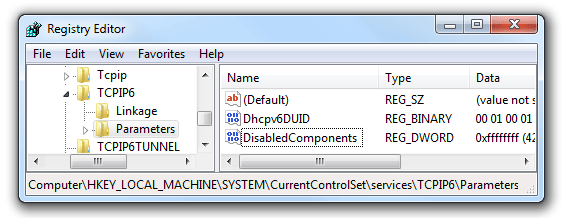 After a reboot IPv6 will be disabled on all interfaces.
This article was updated to reflect Microsoft's new guidance in KB929852 indicating DisabledComponents should be set to FF instead of the previously communicated FFFFFFFF. This will prevent a bootup delay of 5 seconds.
The Java Runtime Environment has become one of the most exploited components of any operating system. Even the US Department of Homeland Security warns users to disable java unless they have a really good reason to use it. For most of us the days of Web sites requiring you to run Java applets has long passed. However, there still are a good number of desktop applications written in Java so simply...
Read More
Port 3389 is the home of the remote desktop protocol that powers Remote Desktop Services on all modern versions of Windows. If your system has Remote Desktop enabled, it is listening for connections on port 3389. Since this port is both well known and can be used to attack accounts, it is low hanging fruit for script kiddies and bots looking for an easy target.
Read More
Microsoft included a batch rename feature in the latest version of Windows allowing you to select multiple files, right click on one and select rename. All of the selected files will be renamed with the name you provided and a number. This functionality works well for basic files but does not provide any flexibility in exactly how the files are numbered and also does not allow the file extension to...
Read More
 The Adobe download manager is part of the normal install of Adobe Reader and Flash that allows Adobe to bundle additional software with their products. After the download manager is installed, Reader/Flash along with other software (Adobe Air) can be downloaded and installed. When dial-up Internet connections where common download managers provided a valuable...
Read More